The Ancient Greek Machine That Predicted the Cosmos
The Antikythera Mechanism: The Ancient Greek Machine That Predicted the Cosmos
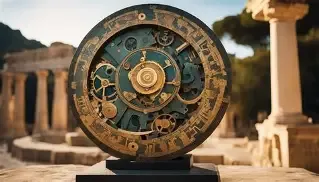
In 1901, divers exploring a Roman-era shipwreck near the Greek island of Antikythera discovered an extraordinary collection of ancient objects.
Among the recovered artifacts was a heavily corroded bronze mechanism that would eventually transform our understanding of ancient Greek technology.
Today, the Antikythera Mechanism is widely regarded as one of the most sophisticated surviving examples of ancient mechanical engineering.
A Computer From the Ancient World
The device contains a complex arrangement of bronze gears designed to represent astronomical cycles.
Research suggests that it could calculate and display information about the movements of the Sun and Moon, predict eclipses, and track important calendar cycles.
Its mechanical complexity is remarkable considering that it dates to approximately the second or first century BCE.
How Did It Work?
The mechanism used interlocking gears operated by a hand-controlled system.
Turning a dial allowed the user to move indicators representing celestial movements and astronomical cycles.
Its surviving fragments contain evidence of carefully designed gear ratios and mathematical relationships.
Modern imaging techniques, including advanced X-ray analysis, have allowed researchers to examine internal structures that cannot be seen from the outside.
Who Created It?
Its exact inventor remains unknown.
The mechanism reflects a sophisticated tradition of Greek astronomy and mechanical engineering, but researchers cannot confidently attribute it to one individual.
It demonstrates that ancient scholars possessed practical knowledge of gearing systems and astronomical calculations that was far more advanced than many people previously imagined.
A Window Into Ancient Science
The Antikythera Mechanism is more than an archaeological curiosity.
It provides direct evidence that ancient civilizations were capable of developing highly sophisticated scientific instruments.
Its discovery reminds us that the history of technology is not a simple story of constant progress. Extraordinary knowledge has existed in different forms throughout human history.